
Many homeowners struggle with cramped layout setups that stifle both movement and sleep quality. You might feel that your only solution is a costly home renovation or a radical minimalist lifestyle that forces you to discard your favorite belongings. As an experienced interior designer who has spent over a decade optimizing micro-apartments and challenging architectural floor plans, I can assure you that the issue is rarely a lack of raw square footage. Instead, it comes down to how you distribute your furniture and trick the human eye.
Learning how to arrange a small bedroom is less about forcing pieces into a tight grid and more about managing visual weight. When you position elements strategically, you completely alter the spatial dynamics of the entire room. Having helped hundreds of clients reclaim their space, I have developed a repeatable system to turn chaotic rooms into breathing sanctuaries. This comprehensive system will transform your cramped sanctuary into an airy, organized oasis by optimizing every square inch of your personal zone.
Things You Need
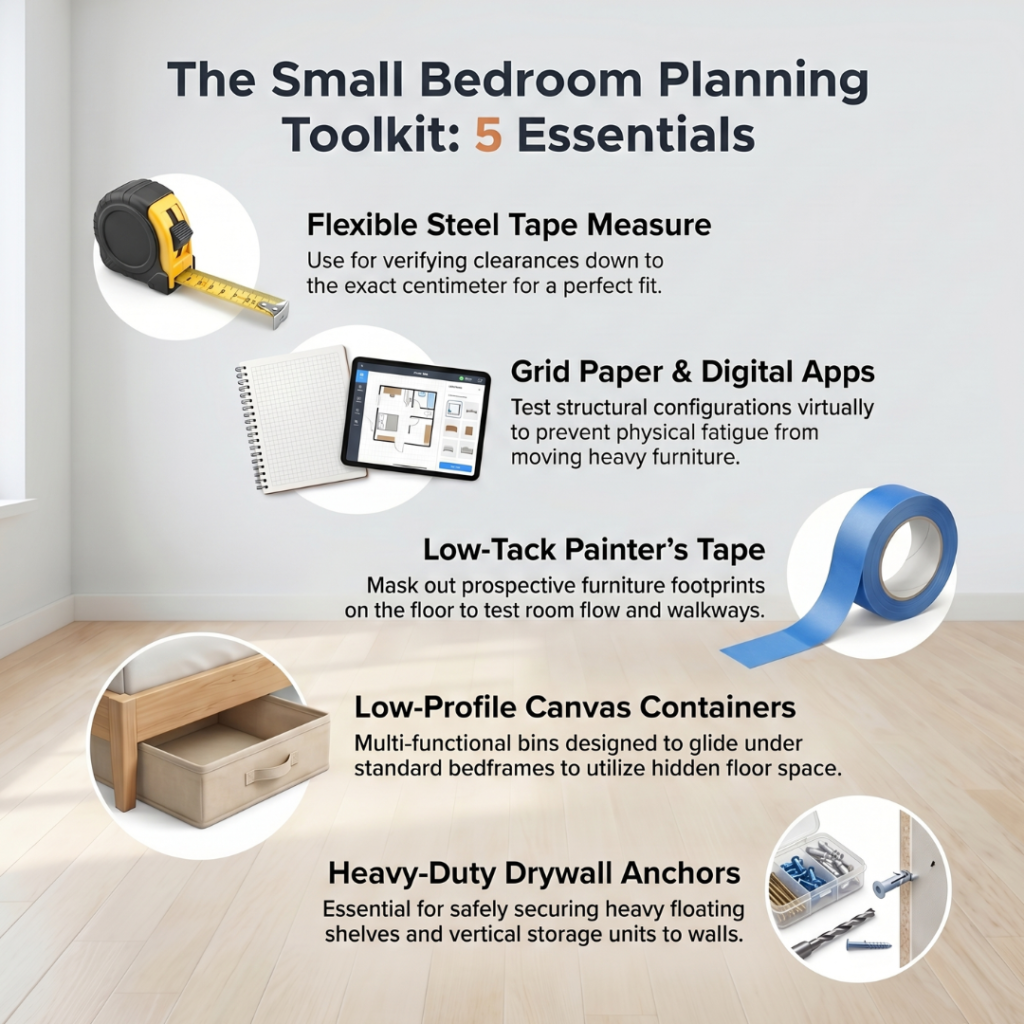
Before moving a single piece of furniture, gather these essential planning and setup tools to streamline your spatial transformation:
A flexible steel tape measure: Crucial for verifying clearances down to the exact centimeter.
Grid paper or a digital floor plan application: Allows you to test structural configurations virtually to prevent physical fatigue.
Low-tack painter’s tape: Excellent for masking out prospective furniture footprints directly onto your floorboards.
Multi-functional canvas storage containers: Specifically look for low-profile bins that easily glide under standard bedframes.
Heavy-duty drywall anchors: Essential for safely securing heavy floating shelves and vertical storage units without risking wall damage.
Step-by-Step Layout Masterclass
Step One: Run a Full Environmental Audit
Clear physical calculations prevent costly spatial mistakes.
Before lifting any heavy objects, map out the true physical boundaries of your floor plan. Knowing the exact dimensions of your walls, window sills, and door swings prevents you from buying pieces that block natural walkways.
To execute this step properly, measure the room at three different heights: baseboard level, waist height, and shoulder height. Older homes often have warped walls that vary by an inch or two, which can completely ruin a tight furniture fit. Mark the location of all electrical outlets, heating vents, and light switches on your sketch so you do not accidentally block them with a massive headboard.
Next, take your roll of painter’s tape and map out the exact dimensions of the furniture you want to include. Walk through the taped-off room for an afternoon. If your shins repeatedly hit the tape boundaries while walking toward the closet, your planned layout needs adjustment before you bring real furniture into the space.
Step Two: Place Your Primary Anchor Tactically
Your largest furniture piece dictates how to arrange a small bedroom successfully.
The bed is the absolute center of gravity in any sleeping space. Forcing a large mattress into the center of a narrow layout can kill room flow, while pushing it into the wrong corner can make the architecture look completely lopsided.
For ultra-compact rectangular rooms, the best approach is pushing the bed into a corner opposite the entryway. This opens up a singular, larger chunk of continuous floor space rather than slicing your room into useless, narrow pathways on either side of the mattress. It also gives you a clear line of sight from the doorway, making the entry feel spacious.
However, if you share the bed, you need at least 24 inches of clearance on both sides to avoid making one person climb over the other. In this scenario, center the headboard against your longest solid wall. To save space, eliminate traditional nightstands and instead use a headboard with built-in side shelving or shallow drawers.
Step Three: Shift Your Storage Focus to Vertical Planes
When floor space disappears completely, look up toward your ceiling.
Walls are the most neglected design assets in compact homes. Pushing your shelving upward draws the human eye toward the ceiling, creating an illusion of height while keeping the floor completely bare.
Instead of a wide, waist-high dresser that steals valuable floor area, use a tall chest of drawers that reaches toward the ceiling. If you need bookstore space, install floating planks that stack vertically all the way up to the molding. You can use the topmost shelves for items you rarely need, like seasonal decor or old photo albums, while keeping daily essentials within arm’s reach.
For lighting, get rid of table lamps that occupy premium surface space on your bedside tables. Hire an electrician to hardwire adjustable swing-arm wall sconces, or buy plug-in sconces that hide their cords behind decorative tracks. This completely clears your nightstand surfaces for items like glasses, water, or a book.
Step Four: Introduce Smart Double-Duty Elements
Every single item must earn its place by performing multiple structural functions.
Single-purpose furniture is a luxury that compact floor plans simply cannot support. Integrating smart, adaptable designs keeps clutter hidden out of sight while serving your daily functional needs.
A classic example is replacing a standard bedframe with a hydraulic lift bed or a frame equipped with deep built-in drawers. This area is the equivalent of a second closet lying flat on your floor. Use it to store bulky items like winter coats, extra linens, and heavy boots that would otherwise jam up your main wardrobe.
If you need a workspace but lack space for a full desk, install a wall-mounted drop-leaf table. This surface folds down flat against the wall when your workday ends, instantly reopening floor space for evening relaxation. Pair it with a sleek, lightweight chair that can double as an accent seat in the corner of the room.
Expert Rules on How to Arrange a Small Bedroom
Rule 1: The Visual Flow Test
Ensure light and air can circulate unhindered across the room.
When analyzing how to arrange a small bedroom, you must look at low visual barriers. Keep the pathway from the entry door to the window completely unobstructed to give the illusion of an open horizon.
Rule 2: Floating Furniture Concepts
Lifting pieces off the ground expands the floor line.
Whenever possible, choose furniture with visible legs rather than solid bases. When your eyes can track the floor all the way to the baseboard, the human brain registers the room as significantly more spacious than it actually is.
Extra Tips for Optical Expansion
Harness Light-Reflecting Materials
Mirrors can make a small room feel twice its actual size by tricking the brain into perceiving depth. Hang a large, frameless mirror directly across from your main window to bounce natural sunlight deep into the darkest corners of the room.
Keep Furniture Legs Long and Lean
The more continuous floor area your eye can track, the larger the room feels. Choose sofas, dressers, and nightstands with tall, slender legs that elevate the furniture base off the ground, rather than solid blocks that sit flat on the carpet.
Standardize Your Hanger Styles
It sounds minor, but visual chaos shrinks physical space. Inside your closet, swap out mismatched plastic and wire hangers for uniform slim velvet hangers; this instantly saves up to 30% of your hanging rod space and makes the closet look professionally organized.
Surprising Spatial Facts
The Floor Space Illusion: Environmental psychology studies demonstrate that keeping 60% of a room’s perimeter floor area completely clear reduces cortisol levels in residents and amplifies the perception of room size.
Receding Color Physics: Cool spectrum tones, such as soft sage green and icy blue, reflect light in a way that makes surfaces appear to recede from the viewer, making walls feel further away.
The Cognitive Load of Clutter: Princeton Neuroscience Institute research confirms that visual clutter competes for your brain’s processing power, which directly intensifies feelings of claustrophobia in tight rooms.
Advantages of Strategic Furniture Placement
Enhanced Sleep Quality
An organized layout eliminates visual noise. When your eyes aren’t jumping from one cluttered pile to another as you drift off, your brain transitions into deep, restorative sleep cycles much faster.
Faster Cleaning Routines
Fewer surface obstacles mean less dust collection and fewer awkward corners to navigate. A compact, optimized space cuts your weekly dusting and vacuuming time down to mere minutes.
Intentional Consumer Habits
Learning the proper techniques on how to arrange a small bedroom stops you from making impulsive purchases. Because you know exactly how limited your storage assets are, you naturally become more selective, buying only high-quality items that you truly love.
Frequently Asked Questions
Is it a bad idea to put a rug in a tight bedroom layout?
Not at all, but size matters immensely here. A tiny rug acts like a visual island and makes the room look fractured. Choose a large rug that extends at least two feet beyond the edges of the bed to unify the layout and stretch the space visually.
How can I hide my clothes if I don’t have a built-in closet?
Use an industrial-style rolling garment rack, but keep it highly curated. Group your clothes by color and length to maintain a clean look. If you prefer things completely hidden, install a floor-to-ceiling curtain track a few feet out from the wall to create a sleek, fabric-walled wardrobe.
Should I avoid dark wall paint in a compact space?
Not necessarily. While light colors brighten rooms, dark shades like navy or charcoal can blur the boundaries of a room by hiding the corner lines. If you use a dark color, paint the baseboards and ceiling the exact same shade to create a seamless, cozy envelope effect.
Final Thoughts
Successfully mastering how to arrange a small bedroom comes down to editing your choices and being intentional with placement. By prioritizing your layout flow, capitalizing on vertical space, and picking multi-functional furniture, you can turn a cramped room into a restful, functional escape. Focus on keeping your floor clear, letting in natural light, and making every piece of furniture count. Don’t be afraid to experiment with your layout until you find the configuration that feels just right for your daily routine.